When Your Brain Won't Quiet Down: How Scent Cuts Through the Anxiety Loop
You know the feeling. One anxious thought leads to another, and before long you're three mental leaps away from the original worry, chest tight, heart racing, completely unable to think your way out. Telling yourself to "just calm down" is about as effective as telling a tornado to slow up. Your brain is running a loop it doesn't know how to exit.
Here's what's interesting though — and this is where aromatherapy gets genuinely fascinating from a science standpoint — scent doesn't have to knock on the same door your anxiety is guarding. It slips in through a side entrance entirely.
The Shortcut Your Anxious Brain Didn't Know Existed
Most of your senses take a fairly long route to reach the parts of your brain that process emotion. Visual information, sound, touch — they all pass through the thalamus first, which acts like a relay station, before eventually reaching the limbic system where emotional responses are generated.
Smell is different. Olfactory signals travel directly to the amygdala and hippocampus — the emotional and memory centers of the brain — without that detour. That's not a small distinction. When you're in an anxiety spiral, your prefrontal cortex (the rational, "let's think this through" part of your brain) is essentially being overridden by your amygdala. Trying to reason your way out of panic is hard precisely because the amygdala has taken the wheel.
But scent? It lands right there in that same emotional neighborhood, which means it can actually influence what's happening neurologically rather than just trying to talk the amygdala down from the outside.
Research has pointed to compounds in certain essential oils — linalool in lavender, for instance — as having measurable effects on the nervous system. Some studies suggest linalool interacts with GABA receptors in the brain, the same receptors that anti-anxiety medications often target. That's not to say your diffuser is a prescription drug. But it does explain why lavender isn't just "nice to smell" when you're anxious — it may be doing something functional.
What Actually Interrupts a Spiral vs. What Just Smells Good
Not every aromatherapy approach is created equal when it comes to anxiety. This is worth being honest about, because plenty of products lean on the "relaxing" label without doing much to interrupt an active anxiety response.
There's a difference between ambient aromatherapy — a diffuser running in the background — and acute aromatherapy, which is a targeted intervention during a moment of distress. Both have their place, but if you're in the middle of a panic attack, passive diffusion is probably not going to cut through fast enough to matter.
What tends to work better in acute situations:
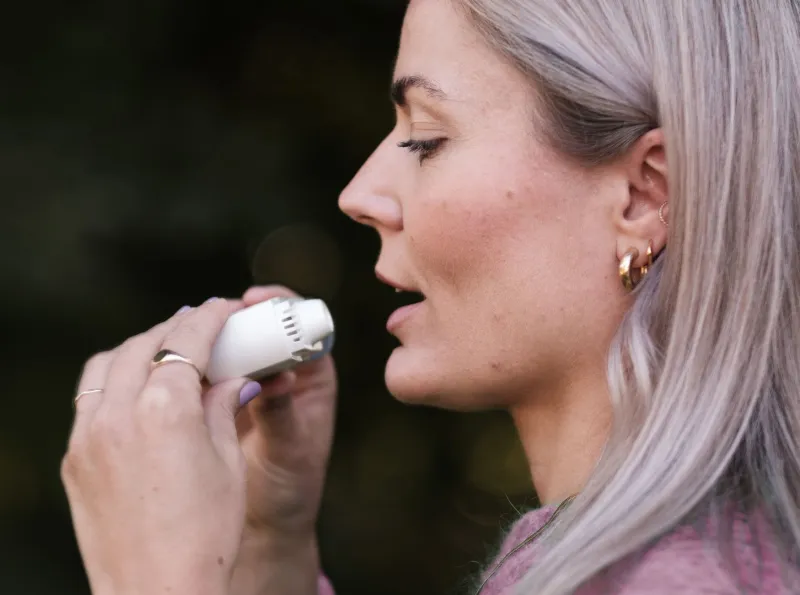
Direct inhalation from a personal inhaler or open bottle. Holding an aromatherapy inhaler under your nose and taking slow, deliberate breaths accomplishes two things simultaneously. The scent itself begins its neurological work, but the deliberate slow breathing also activates your parasympathetic nervous system — your body's "rest and digest" mode. You're essentially hitting two reset buttons at once.
Grounding blends over purely sedating ones. During active anxiety, heavily sedating oils can sometimes feel disorienting, which can actually increase panic in some people. Blends that combine a calming base (like cedarwood or vetiver) with something slightly clarifying (like a touch of frankincense or bergamot) tend to help people feel settled rather than foggy.
Temperature contrast with scent. Some practitioners pair cool water on the wrists with a grounding oil like sandalwood. The cold activates the dive reflex, which slows heart rate, while the scent engages the limbic system. It's a one-two combination that many clients describe as surprisingly effective.
Real Scenarios, Real Protocols
Let's get practical. Here's how some of our clients at Aroma Spa Wellness have described using scent-based protocols during anxiety episodes — and what actually helped.
The late-night spiral. One client described waking at 2 a.m. with racing thoughts about work. She'd tried everything — phone away, no screens, deep breathing — but her mind kept cycling. She started keeping a roller blend of lavender, cedarwood, and a drop of ylang ylang on her nightstand. Rolling it on her wrists and the back of her neck while doing slow box breathing (inhale four counts, hold four, exhale four, hold four) became a ritual her nervous system learned to recognize as a signal to downshift. Within a few weeks, the association was strong enough that just reaching for the roller started the calming response.
The pre-presentation panic. Another client, a teacher who dealt with acute anxiety before speaking in front of large groups, used a personal inhaler with a blend of bergamot and frankincense. He'd take three slow inhales before entering a room. The bergamot, which research has associated with reduced anxiety and improved mood, paired with the grounding quality of frankincense gave him something concrete to do with his nervous energy while also engaging that direct olfactory-to-limbic pathway.
The situational dread loop. Generalized anxiety often shows up as low-grade, persistent dread rather than acute panic. For this pattern, consistent ambient aromatherapy can build a genuine baseline. Diffusing a blend of clary sage, roman chamomile, and a small amount of patchouli during intentional wind-down time each evening helps the nervous system practice the transition from alert to at-ease — which makes that transition easier to access during the day.
Building Your Own Anxiety Protocol
If you want to start using aromatherapy more strategically for anxiety, here's a simple framework:
-
Identify your anxiety pattern. Is it acute panic, nighttime rumination, or persistent background dread? Different patterns call for different approaches.
-
Choose your delivery method accordingly. Personal inhalers for acute moments. Roller blends for ritualized use. Diffusers for ambient baseline support.
-
Pick oils with evidence behind them. Lavender (linalool), bergamot, frankincense, cedarwood, and clary sage all have some research support for anxiety-related effects. You don't need a complex blend — sometimes two or three oils work better than six.
-
Pair scent with a physical practice. Deep breathing, grounding through the senses, or even just placing both feet flat on the floor. The combination trains your nervous system more effectively than scent alone.
-
Be consistent before you're in crisis. The more your brain associates a particular scent with calm, the faster that association kicks in when you actually need it. Use your chosen blend during low-anxiety moments too.
The Honest Bottom Line
Aromatherapy isn't a cure for anxiety disorders, and it shouldn't be positioned as a replacement for professional mental health care. But it's also not just a pleasant distraction. For a lot of people, it's one of the only tools that can reach into an active anxiety loop and gently pull the emergency brake — not because it's magic, but because of where and how scent interacts with the brain.
That's worth knowing. And it's worth having a protocol ready before the next spiral starts.