Why Your Bathroom Still Doesn't Feel Like a Spa (And It's Not Because You Need More Candles)
The Pinterest Trap
There's a very specific kind of disappointment that hits when you've carefully arranged your bathroom with every wellness product you've collected over the past two years, drawn a bath, turned on the diffuser, and... still feel like you're in your bathroom.
You've done everything the Instagram posts told you to do. The aesthetic is there. The products are there. But the feeling — that particular kind of deep, cellular exhale that happens within sixty seconds of walking into a real spa — isn't there.
Here's the thing: it's not a product problem. It's an environment problem. And the gap between what spas do and what home setups do is almost never about what's in the bottles.
What Spas Are Actually Doing (That Nobody Advertises)
Professional spa designers spend serious time and money on four things that most home wellness guides never mention: light, sound, humidity, and scent layering. Not any one of these alone — all four, working together, calibrated to create a specific physiological response before a single treatment begins.
This is called environmental therapy design, and it's why the experience starts the moment you walk through the door, not when the massage therapist puts their hands on you.
Lighting That Tells Your Nervous System to Stand Down
Most home bathrooms have overhead lighting. Overhead lighting is the enemy of relaxation. It's the same angle as sunlight at noon — the angle your nervous system evolved to associate with alertness, vigilance, and activity.
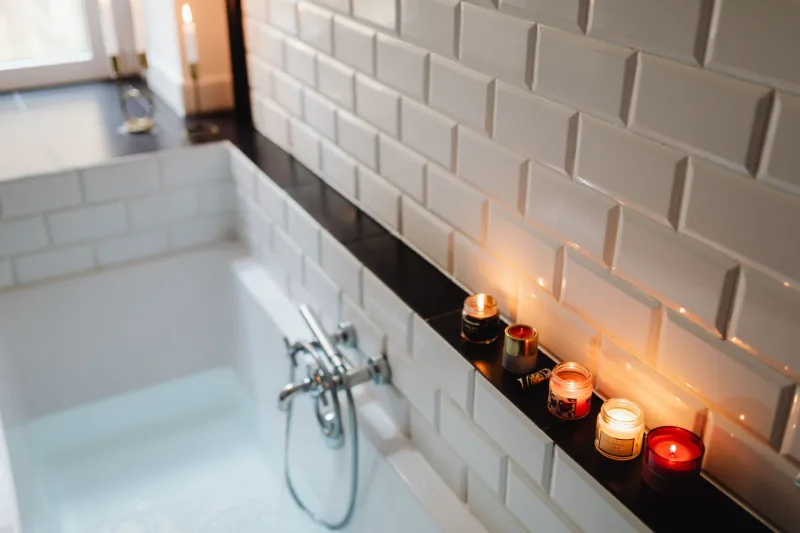
Spas use layered, low, warm light sources positioned at eye level or below. Think: sconces, floor-level accent lights, candlelight. The color temperature matters too — anything above 3000 Kelvin reads as "daytime" to your brain. Spa lighting typically sits around 2200–2700 Kelvin, the range that signals evening and safety.
What you can do: Turn off your overhead light entirely. Use a few warm-toned LED candles or plug-in accent lights near the floor or tub level. A $15 smart bulb that shifts to 2200K warm white will do more for your spa experience than a $60 bath product.
Sound That Isn't Just "Relaxing Music"
The ambient soundscapes in high-quality spas aren't just whatever's on the Spotify spa playlist. They're engineered to mask the sounds of the outside world — HVAC hum, street noise, the refrigerator cycling on — while delivering frequencies that actively support parasympathetic nervous system activation.
Many spas use binaural audio or music specifically composed around 60 BPM (the tempo associated with resting heart rate entrainment). They also pay attention to sound absorption — soft surfaces, thick towels, rugs, upholstered furniture — so the room itself doesn't create harsh reflections.
Your tiled bathroom is an echo chamber. Hard surfaces bounce every small sound back at you, creating a subtle but constant low-level stimulation that prevents full relaxation.
What you can do: Add a thick bath mat, hang a fabric shower curtain instead of glass or plastic, and put a small folded towel on any hard surfaces. Then find a 60 BPM playlist or a binaural beats track in the theta range (4–8 Hz). Use a small Bluetooth speaker and position it away from you, not pointed directly at your face.
Humidity and Temperature That Actually Feel Like Something
One of the most underrated elements of a professional spa is the air itself. Steam rooms, warm towels, humidity-controlled treatment rooms — these aren't luxury extras. They're doing specific physiological work.
Warm, humid air opens the airways, enhances the delivery of aromatic compounds to your olfactory receptors, and signals physical warmth and safety to a nervous system that's been conditioned to associate cold with threat. It also means the essential oils you're diffusing are actually reaching you more effectively.
Most home bathrooms are dry and whatever temperature the rest of the house is, which is rarely the 78–82°F sweet spot that spa treatment rooms aim for.
What you can do: Run your shower on hot for two minutes before your bath to build steam and warm the room. Add a small humidifier if your bathroom is particularly dry. And actually heat the room — a small ceramic space heater on a timer can pre-warm the space before you get in.
Scent Layering, Not Scent Bombing
Here's where most home setups go wrong: they use one product, at full intensity, and call it aromatherapy. Spas use scent in layers, at different intensities, in different zones.
You might encounter a light citrus note in the reception area, a deeper, woodsier blend in the changing room, and a specific therapeutic oil in the treatment room itself. Each layer is subtle enough that you're not consciously registering "smell" — you're just registering calm.
Home diffusers, especially ultrasonic ones running in a small enclosed bathroom, often over-saturate the space. Instead of a gentle signal to your nervous system, you get a loud one. Paradoxically, less oil often works better.
What you can do: Use your diffuser at half the recommended amount of oil. Add a second, lighter scent element — a few drops on a wooden disc near the door, or a cotton ball tucked near the vent — to create a subtle layering effect. Let the scent be something you notice softly rather than something that announces itself.
The One Thing Money Can't Buy
All of that said, there's one element of the spa experience that no product or environmental tweak can fully replicate at home: the removal of responsibility.
At a spa, someone else is in charge. You don't have to remember to turn off the diffuser or worry about the towels or think about what's for dinner. The experience of being cared for — of having nothing required of you — is itself deeply therapeutic.
You can approximate this at home by creating a ritual around your spa time: phone in another room, a do-not-disturb sign on the door if you have housemates, and a genuine commitment to treating this time as non-negotiable. It sounds simple. It's actually the hardest part.
Start With Environment, Not Products
If you take nothing else from this, take this: the next time you're tempted to buy another wellness product to improve your home spa experience, spend that money on your environment instead. A warm-toned bulb, a better bath mat, a small humidifier. Fix the container before you keep adding to what's inside it.
The spa feeling you're chasing isn't locked inside a bottle. It's a combination of sensory conditions that tell your nervous system, unambiguously, that it is safe to rest. Create those conditions, and the oils you already have will finally get to do their job.