When Relaxing Becomes Homework: The Quiet Pressure Hiding Inside Wellness Culture
At some point in the last decade, wellness stopped being a personal thing and became a public one. The diffuser on your desk, the oils lined up on your bathroom shelf, the morning ritual you may or may not actually do—these became signals. Proof of a certain kind of life. Evidence that you were taking care of yourself correctly.
And somewhere in that shift, aromatherapy—one of the most fundamentally low-stakes, sensory-pleasure-based practices in existence—picked up a layer of pressure it was never designed to carry.
This is worth talking about honestly, because the irony is genuinely striking: people are stressed out about their relaxation practices. They feel guilty about not diffusing. They wonder if they're using the wrong oils. They read about someone's elaborate morning ritual and feel behind, somehow, in their own self-care.
If any of that sounds familiar, this is for you.
How Wellness Got Weaponized
Wellness culture in America didn't start out as performance. But somewhere between the rise of Instagram aesthetics, the influencer economy, and the commodification of every conceivable health practice, it quietly shifted.
The problem isn't that people share their wellness routines. The problem is the implicit message that tends to travel with those shares: this is what doing it right looks like. The perfectly curated oil collection. The exact diffuser blend for Monday morning productivity. The crystal-infused roller bottle used in a specific sequence at a specific time for specific results.
When wellness content is produced at scale and optimized for engagement, it naturally gravitates toward the aspirational and the specific. Aspirational because it generates desire. Specific because it generates authority. Neither of those things is inherently bad, but together they create a landscape where the average person scrolling through their feed starts to feel like their imperfect, inconsistent, just-grabbed-whatever-was-nearby practice doesn't count.
And that's where aromatherapy, of all things, starts producing stress instead of relieving it.
The Right Oils Myth
Let's be direct about something: there are no universally right oils. There are oils with documented effects, oils that work well for certain purposes, and oils that are higher quality than others—but the idea that you need a specific curated collection to have a legitimate aromatherapy practice is a retail strategy, not a wellness truth.
The olfactory system is intensely personal. What produces calm in one person can produce agitation in another. This isn't a failure of the oil or the person—it's basic neuroscience. Scent associations are formed through lived experience, and no two people have the same experiences. The oil that your favorite wellness influencer swears by may do absolutely nothing for you, and that doesn't mean you need a different oil. It might mean that particular scent just isn't yours.
The pressure to have the right oils often leads people to accumulate collections they don't actually connect with—purchased because they were recommended, not because they resonated. Then those bottles sit unused, generating guilt, reinforcing the sense that you're somehow not doing this right.
Start with what you actually like. That is the right oil.
Protocols Are Tools, Not Tests
Aromatherapy protocols—specific blends, application methods, timing recommendations—exist because they can be genuinely useful. Having a framework removes decision fatigue and creates consistency, both of which support habit formation.
But protocols also have a shadow side. When they're presented as the correct way to practice, they become a standard against which your actual practice gets measured and found wanting. Didn't do your evening wind-down blend? Failed. Used your morning focus oil in the afternoon because that's when you needed it? Wrong.
This is backwards. A protocol is a starting suggestion, not a rule. The goal of any aromatherapy practice is a physiological and emotional outcome—reduced tension, better sleep, improved focus, a moment of genuine sensory pleasure. If you achieve that outcome without following a protocol, you haven't cheated. You've succeeded.
Practitioners who've worked in the field for years will tell you that the most effective aromatherapy is the kind that people actually use. An elaborate protocol that gets abandoned after two weeks does nothing. A single oil that someone reaches for consistently because it genuinely helps them does a lot.
Measuring Your Relaxation Is Not Relaxing
One of the stranger developments in modern wellness culture is the quantification of rest. Sleep scores, HRV readings, recovery metrics, stress tracking apps—all of these can be useful tools, but they've also created a situation where people are anxious about whether they're relaxed enough.
Aromatherapy has gotten pulled into this. People wonder if their cortisol is actually dropping. They look for measurable proof that the lavender is working. They feel like they should be more relaxed than they are, which is itself a stressful thought.
Here's a permission slip: you don't have to measure it. You don't have to optimize it. You don't have to prove it's working by any standard other than this felt good, or at least okay, and I'm glad I did it.
Scent is one of the few sensory inputs that bypasses the analytical brain almost entirely on its way to the emotional processing centers. The moment you start intellectualizing your aromatherapy practice—evaluating it, grading it, comparing it to what it should be—you're working against the mechanism that makes it effective in the first place.
What Permission-Based Aromatherapy Actually Looks Like
Permission-based aromatherapy is a phrase worth sitting with. It means approaching your practice not as a set of requirements to fulfill but as a set of options available to you—options you can take or leave based on what you actually need on any given day.
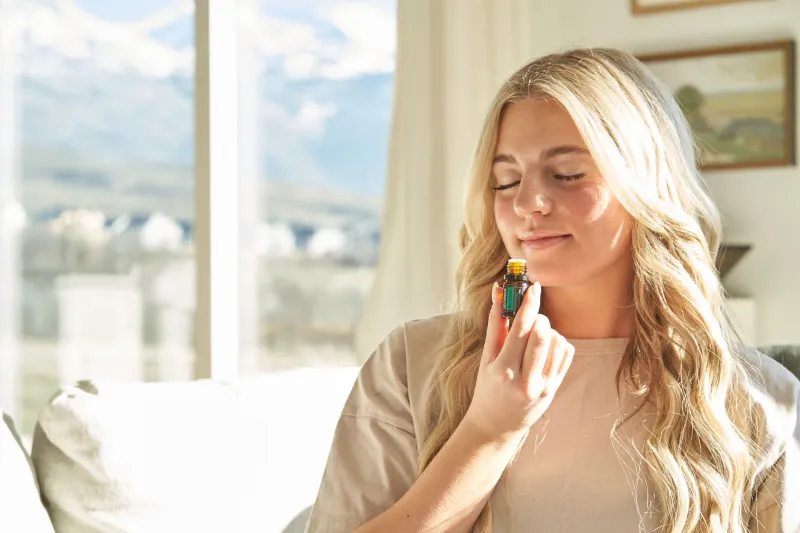
Some days that might look like a carefully prepared diffuser blend used during a twenty-minute intentional rest. Other days it might look like uncapping a bottle, taking three slow breaths, and moving on with your life. Both of those count. Both of those do something.
It means dropping the comparison—to the person with the beautiful shelfie of forty perfectly labeled bottles, to your own past self who had a more consistent practice, to the ideal version of wellness that exists in content but not in real life.
It means letting aromatherapy be as uncomplicated as it was before anyone told you there was a right way to do it. A scent you like. A moment to breathe. That's genuinely enough.
The Actual Point
Aromatherapy, at its core, is about using scent as a bridge to a more settled state. It's rooted in the oldest, most primal form of sensory experience humans have. Long before there were protocols or influencers or curated collections, people were drawn to certain plants because they smelled good and seemed to help.
That instinct is still valid. It doesn't need to be optimized, quantified, or performed for anyone. The moment your aromatherapy practice starts adding to your stress instead of reducing it, the practice needs to change—not you.
Breathing deeply shouldn't feel like homework. If it does, something has gone sideways in how wellness culture has framed it for you. And the fix isn't a better protocol. It's giving yourself permission to just... smell something nice and see what happens.